 |
|
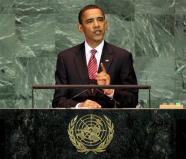
Tổng Thống Hoa Kỳ Obama tại cuộc họp thượng đỉnh Liên Hiệp Quốc |
Tin từ Oslo: Tổng Thống Obama được tặng giải Hòa Bình Nobel năm 2009 vào ngày Thứ Sáu (9/10/2009) làm cho mọi người ngạc nhiên. Quyết định của Ủy Ban Hòa Bình Nobel về việc này mục đích là để khích lệ những sáng kiến của Obama về giảm thiểu vũ khí nguyên tử, giảm bớt sự căng thẳng với các quốc gia Hồi Giáo, và chú trọng đến ngoại giao và cộng tác với các quốc gia trên thế giơi thay vì làm việc đơn phương.
Sự bầu chọn bất ngờ và quá sớm trong thời gian giữ chức vụ Tổng Thống Hoa Kỳ của Obama (chỉ mới bắt đầu hai tuần lễ trước hạn chót đề nghị giải Nobel ngày 01 tháng hai) đã làm cho các nhà quan sát Giải Nobel vô cùng sửng sốt.
Ông Robert Gibbs, trưởng phòng báo chí Tòa Bạch Ốc cho hay là Tổng Thống Obama được tin này khi tỉnh dậy vào lúc trước 6 giờ sáng (giờ Hoa Thịnh Đốn). Tòa Bạch Ốc chưa có ý kiến tức thời về nguồn tin đột ngột này.
Ủy Ban Hòa Bình Na Uy ca ngợi sự biến chuyển tâm trạng thế giới do việc Tổng
Thống Obama kêu gọi các quốc gia trên thế giới hãy cộng tác với nhau cho việc
kiến tạo hòa bình, nhưng cũng nhận thấy những sáng kiến này hãy còn chưa mang
lại kết quả:
- làm giảm bớt số lương tàng trừ về
vũ khí hạch nhân,
- làm giảm bớt sự căng thẳng và chiến
tranh giữa Hoa Kỳ và các quốc gia Hồi Giáo, và
- tăng cường vai trò của Hoa Kỳ trong
cuộc chiến làm thay đổi khí hậu địa cầu.
"Hiếm khi có một người như Obama có thể thu hút được sự chú ý của công chúng
thế giới và mang đến niềm hy vọng cho dân chúng nước ông về một tương lai tốt
đẹp hơn", ông Thorbjoern Jagland, chủ
tịch của ủy ban trao giải Nobel cho biết như thế.
Cựu Tổng Thống Ba Lan Lech Walesa, khôi nguyên Nobel Hòa Bình 1983 cho rằng
ông Obama dược trao giải quá sớm, vì “ông ta chưa làm được gì cả”, nhưng
cũng bảo thêm rằng “phải cho ông ta cơ hội” và giải thường được dùng “để
thúc đẩy ông Obama phải hành động”
Giải thưởng này là một cái tát cho cựu Tổng Thống George
Bush do một ủy ban đã từng chỉ trích gay gắt vị tổng thống tiền nhiệm của Obama
về hành vi quân sự đơn phương về những cú tấn công của quân khủng bố ngày 11
tháng 9. Hội đồng tuyển chọn giải Nobel khen ông Obama đã sáng tạo "một làn gió
mới trong chính trường quốc tế" và nói ông Obama đã đem chính sách ngoại giao
đa phương và những tổ chức như Hội Đồng Liên Hiệp Quốc trở về sân khấu toàn cầu.
...
(SH tóm lược)
In a surprise, Obama wins Nobel Peace Prize
https://news.yahoo.com/s/ap/20091009/ap_on_re_eu/eu_nobel_peace_21
By KARL RITTER and MATT MOORE, Associated Press Writers Karl Ritter And Matt
Moore, Associated Press Writers
OSLO – President Barack Obama won the 2009 Nobel Peace Prize on Friday in a
stunning decision designed to encourage his initiatives to reduce nuclear arms,
ease tensions with the Muslim world and stress diplomacy and cooperation rather
than unilateralism.
Nobel observers were shocked by the unexpected choice so early in the Obama
presidency, which began less than two weeks before the Feb. 1 nomination
deadline.
White House press secretary Robert Gibbs said Obama woke up to the news a little
before 6 a.m. EDT. The White House had no immediate comment on the announcement,
which took the administration by surprise.
The Norwegian Nobel Committee lauded the change in global mood wrought by
Obama's calls for peace and cooperation
but recognized initiatives that have yet to bear fruit:
reducing the world stock of nuclear arms, easing American conflicts with Muslim
nations and strengthening the U.S. role in combating climate change.
"Only very rarely has a person to the same extent as Obama captured the world's
attention and given its people hope for a better future," said Thorbjoern
Jagland, chairman of the Nobel Committee.
Still, the U.S. remains at war in Iraq and Afghanistan, the U.S. Congress has
yet to pass a law reducing carbon emissions and there has been little
significant reduction in global nuclear stockpiles since Obama took office.
"So soon? Too early. He has no contribution so far. He is still at an early
stage. He is only beginning to act," said former Polish President Lech Walesa, a
1983 Nobel Peace laureate.
"This is probably an encouragement for him to act. Let's see if he perseveres.
Let's give him time to act," Walesa said.
The award appeared to be a slap at President George W. Bush from a committee
that harshly criticized Obama's predecessor for his largely unilateral military
action in the wake of the Sept. 11 terror attacks. The Nobel committee praised
Obama's creation of "a new climate in international politics" and said he had
returned multilateral diplomacy and institutions like the U.N. to the center of
the world stage.
Archbishop Desmond Tutu of South Africa, who won the prize in 1984, said Obama's
award shows great things are expected from him in coming years.
"It's an award coming near the beginning of the first term of office of a
relatively young president that anticipates an even greater contribution towards
making our world a safer place for all," Tutu said. "It is an award that speaks
to the promise of President Obama's message of hope."
Until seconds before the award, speculation had focused on a wide variety of
candidates besides Obama: Zimbabwe's Prime Minister Morgan Tsvangirai, a
Colombian senator, a Chinese dissident and an Afghan woman's rights activist,
among others. The Nobel committee received a record 205 nominations for this
year's prize, though it was not immediately apparent who nominated Obama.
"The exciting and important thing about this prize is that it's given to someone
... who has the power to contribute to peace," Norwegian Prime Minister Jens
Stoltenberg said.
Obama is the third sitting U.S. president to win the award: President Theodore
Roosevelt won in 1906 and President Woodrow Wilson was awarded the prize in
1919.
The Nobel committee chairman said after awarding the 2002 prize to former
Democratic President Jimmy Carter, for his mediation in international conflicts,
that it should be seen as a "kick in the leg" to the Bush administration's hard
line in the buildup to the Iraq war.
Five years later, the committee honored Bush's adversary in the 2000
presidential election, Al Gore, for his campaign to raise awareness about global
warming.
Obama was to meet with his top advisers on the Afghan war on Friday to consider
a request by Gen. Stanley McChrystal, the U.S. commander in Afghanistan, to send
as many as 40,000 more troops to Afghanistan as the U.S war there enters its
ninth year.
Obama ordered 21,000 additional troops to Afghanistan earlier this year and has
continued the use of unmanned drones for attacks on militants in Afghanistan and
Pakistan, a strategy devised by the Bush administration. The attacks often kill
or injure civilians living in the area.
In
July talks in Moscow, Obama and Russian President Dmitry Medvedev agreed that
their negotiators would work out a new limit on delivery vehicles for nuclear
warheads of between 500 and 1,100. They also agreed that warhead limits would be
reduced from the current range of 1,700-2,200 to as low as 1,500. The United
States now as about 2,200 such warheads, compared to about 2,800 for the
Russians.
But there has been no word on whether either side has started to act on the
reductions.
Former Peace Prize winner Mohamed ElBaradei, director general of the
International Atomic Energy Agency in Vienna, said Obama has already provided
outstanding leadership in the effort to prevent nuclear proliferation.
"In less than a year in office, he has transformed the way we look at ourselves
and the world we live in and rekindled hope for a world at peace with itself,"
ElBaradei said. "He has shown an unshakeable commitment to diplomacy, mutual
respect and dialogue as the best means of resolving conflicts."
Obama also has attempted to restart stalled talks between the Israelis and
Palestinians, but just a day after Obama hosted the Israeli and Palestinian
leaders in New York, Israeli officials boasted that they had fended off U.S.
pressure to halt settlement construction. Moderate Palestinians said they felt
undermined by Obama's failure to back up his demand for a freeze.
Nominators for the prize include former laureates; current and former members of
the committee and their staff; members of national governments and legislatures;
university professors of law, theology, social sciences, history and philosophy;
leaders of peace research and foreign affairs institutes; and members of
international courts of law.
The Nelson Mandela Foundation welcomed the award on behalf of its founder Nelson
Mandela, who shared the 1993 Peace Prize with then-South African President F.W.
DeKlerk for their efforts at ending years of apartheid and laying the groundwork
for a democratic country.
"We trust that this award will strengthen his commitment, as the leader of the
most powerful nation in the world, to continue promoting peace and the
eradication of poverty," the foundation said.
In
his 1895 will, Alfred Nobel stipulated that the peace prize should go "to the
person who shall have done the most or the best work for fraternity between the
nations and the abolition or reduction of standing armies and the formation and
spreading of peace congresses."
Unlike the other Nobel Prizes, which are awarded by Swedish institutions, he
said the peace prize should be given out by a five-member committee elected by
the Norwegian Parliament. Sweden and Norway were united under the same crown at
the time of Nobel's death.
The committee has taken a wide interpretation of Nobel's guidelines, expanding
the prize beyond peace mediation to include efforts to combat poverty, disease
and climate change.